
PAGE CONTENTS
ToggleEvery golfer wants to know, “Am I hitting my irons far enough?” The old rule of thumb says a typical player should carry a 7-iron about 150 yards with a tidy 10-yard gap between clubs.
But real-world data from platforms like Shot Scope and Arccos, tracking millions of actual on-course shots, tells a much more nuanced story.
Your iron distance depends heavily on your handicap index, age, swing speed, equipment loft, and strike quality.
Fully 46% of the 2.79 strokes per round Tiger Woods gained over the PGA Tour average in his prime came from flying darts into the pins, a testament that knowing your iron distances and which stick to grab is one of the quickest paths to lower scores.
In this guide, we break down average iron distances and provide a golf club distance chart across all major handicap categories, age groups, and swing speed tiers, offering a comprehensive real golf club distance chart in both yards and meters. This allows you to benchmark your game and identify areas where there’s room for improvement.
New to golf? Read our guide to know basic golf rules: Basic Golf Rules for Beginners.
Comprehensive Iron Distance Chart by Skill Level
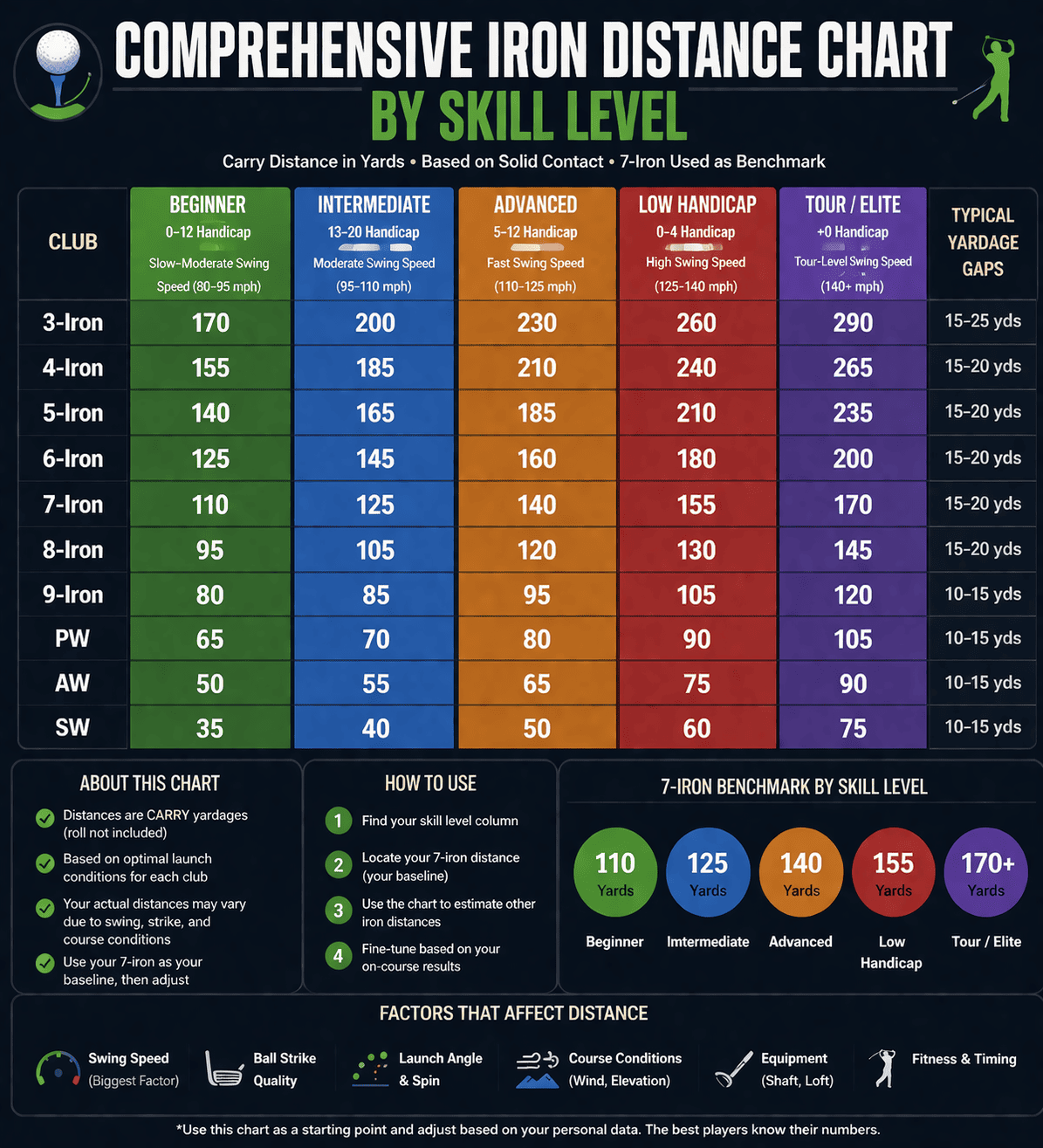
This section gives specific carry ranges, how handicaps change those ranges, per-club numbers, and differences by sex and age, so you can set realistic yardage targets and build a reliable club distance chart.
Standard Iron Distance Chart
Use this standard iron distance chart as a starting point for carry yards with centered strikes and typical amateur swing speeds. These are carry ranges, not total distance.
All golf distance measurements fit into one of two categories. Carry distance is the distance the ball travels before it initially touches ground; that’s the number that matters most for club selection, especially when you need to clear a bunker or water hazard or get on a green.
Total distance incorporates the roll after you land. TrackMan’s PGA Tour data is based on carry distance, while Shot Scope and Arccos report total distance in the amateur department.
When you encounter numbers that vary across sources, always verify which measurement is being referenced; the difference can range from 5 to 15 yards per iron, depending on ground conditions, descent angle, and spin rate.
Ball Speed, Smash Factor, and Energy Transfer
Ball speed, the speed at which the ball leaves the clubface, is the single strongest predictor of carry distance. Two golfers can swing at identical clubhead speeds yet produce very different ball speeds depending on where they strike the face and how they deliver loft.
This efficiency is measured by smash factor, calculated as ball speed divided by clubhead speed. Most amateur golfers produce iron smash factors between 1.33 and 1.45.
A typical 7-iron struck at 85 mph clubhead speed with a smash factor of 1.38 produces roughly 117 mph of ball speed, enough to carry approximately 145–150 yards in standard conditions.
Improving strike quality (finding the center of the face more often) is usually the fastest route to gaining distance without swinging harder.
Launch Angle, Spin Rate, and Descent Angle
Ball speed, the speed at which the ball leaves the clubface, is the single strongest predictor of carry distance. Two golfers can swing at identical clubhead speeds yet produce very different ball speeds depending on where they strike the face and how they deliver loft.
This efficiency is measured by smash factor, calculated as ball speed divided by clubhead speed. Most amateur golfers produce iron smash factors between 1.33 and 1.45.
A typical 7-iron struck at 85 mph clubhead speed with a smash factor of 1.38 produces roughly 117 mph of ball speed, enough to carry approximately 145–150 yards in standard conditions.
Improving strike quality (finding the center of the face more often) is usually the fastest route to gaining distance without swinging harder.
Dynamic Loft vs. Static Loft
Dynamic loft, the actual loft presented to the ball at impact, is the only thing that affects ball flight, not the number on the sole. A player who holds his/her shaft leaning forward at impact effectively reduces loft (delofts the club), creating lower launch, less spin, and more distance.
A wrist-flipper who adds loft turns a 7-iron into an 8-iron in launch characteristics. This is also why the same numbered club in different golfers’ hands can result in wildly different distances and why the angle of attack (the steepness of your downswing) is so important to iron compression and consistency.
Understanding Golf Handicap Levels By Iron Distance Chart
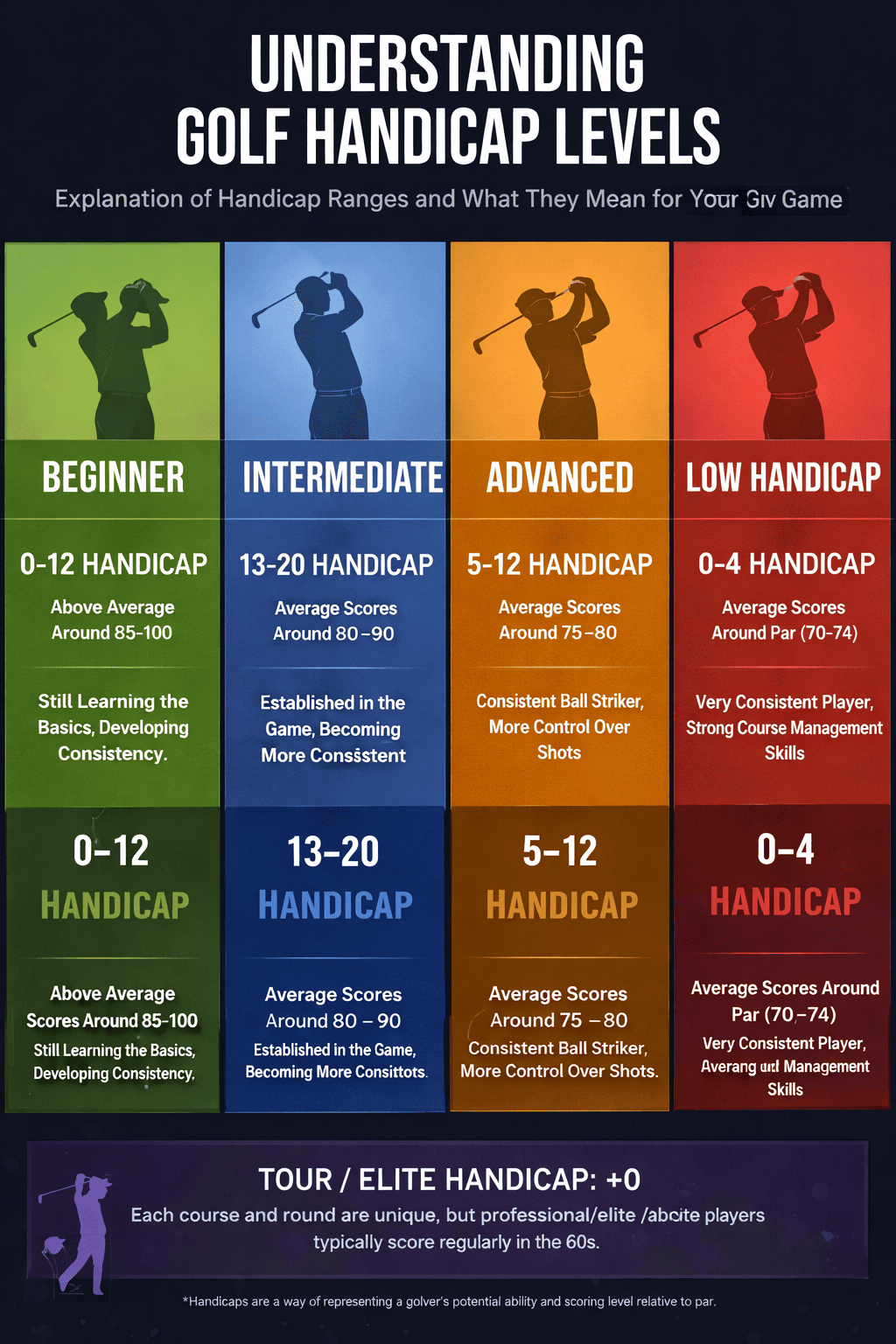
Before diving into the distance tables, here’s a quick overview of how handicap categories are typically grouped in amateur golf. These are the standard brackets used by data providers like Shot Scope and Arccos when analyzing performance.
25 handicap:
| Club | P-Avg Distance (yards) |
| Driver | 200 yds |
| 3-Wood | 175 yds |
| 4-Hybrid | 160 yds |
| 4-Iron | 150 yds |
| 5-Iron | 140 yds |
| 6-Iron | 135 yds |
| 7-Iron | 130 yds |
| 8-Iron | 120 yds |
| 9-Iron | 110 yds |
| Pitching Wedge | 100 yds |
| Gap Wedge | 85 yds |
| Sand Wedge | 70 yds |
| Lob Wedge | 50 yds |
20 handicap:
| Club | P-Avg Distance (yards) |
| Driver | 220 yds |
| 3-Wood | 195 yds |
| 4-Hybrid | 180 yds |
| 4-Iron | 165 yds |
| 5-Iron | 155 yds |
| 6-Iron | 148 yds |
| 7-Iron | 142 yds |
| 8-Iron | 133 yds |
| 9-Iron | 125 yds |
| Pitching Wedge | 110 yds |
| Gap Wedge | 95 yds |
| Sand Wedge | 80 yds |
| Lob Wedge | 60 yds |
15 handicap:
| Club | P-Avg Distance (yards) |
| Driver | 235 yds |
| 3-Wood | 215 yds |
| 4-Hybrid | 195 yds |
| 4-Iron | 180 yds |
| 5-Iron | 170 yds |
| 6-Iron | 160 yds |
| 7-Iron | 150 yds |
| 8-Iron | 140 yds |
| 9-Iron | 130 yds |
| Pitching Wedge | 120 yds |
| Gap Wedge | 105 yds |
| Sand Wedge | 85 yds |
| Lob Wedge | 65 yds |
10 handicap:
| Club | P-Avg Distance (yards) |
| Driver | 255 yds |
| 3-Wood | 230 yds |
| 4-Hybrid | 210 yds |
| 4-Iron | 195 yds |
| 5-Iron | 180 yds |
| 6-Iron | 170 yds |
| 7-Iron | 160 yds |
| 8-Iron | 148 yds |
| 9-Iron | 138 yds |
| Pitching Wedge | 125 yds |
| Gap Wedge | 110 yds |
| Sand Wedge | 90 yds |
| Lob Wedge | 70 yds |
5 handicap:
| Club | P-Avg Distance (yards) |
| Driver | 265 yds |
| 3-Wood | 240 yds |
| 4-Hybrid | 220 yds |
| 4-Iron | 200 yds |
| 5-Iron | 185 yds |
| 6-Iron | 172 yds |
| 7-Iron | 165 yds |
| 8-Iron | 150 yds |
| 9-Iron | 140 yds |
| Pitching Wedge | 130 yds |
| Gap Wedge | 115 yds |
| Sand Wedge | 95 yds |
| Lob Wedge | 75 yds |
0 scratch handicap:
| Club | P-Avg Distance (yards) |
| Driver | 285 yds |
| 3-Wood | 260 yds |
| 4-Hybrid | 235 yds |
| 4-Iron | 220 yds |
| 5-Iron | 200 yds |
| 6-Iron | 185 yds |
| 7-Iron | 175 yds |
| 8-Iron | 160 yds |
| 9-Iron | 150 yds |
| Pitching Wedge | 140 yds |
| Gap Wedge | 125 yds |
| Sand Wedge | 105 yds |
| Lob Wedge | 85 yds |
Pro tip: If your 5-iron and 6-iron are only separated by 5 yards or less, consider replacing the long iron with a hybrid. Many mid-to-high handicappers gain both distance and accuracy by making this switch.
Factors That Affect Your Iron Distance
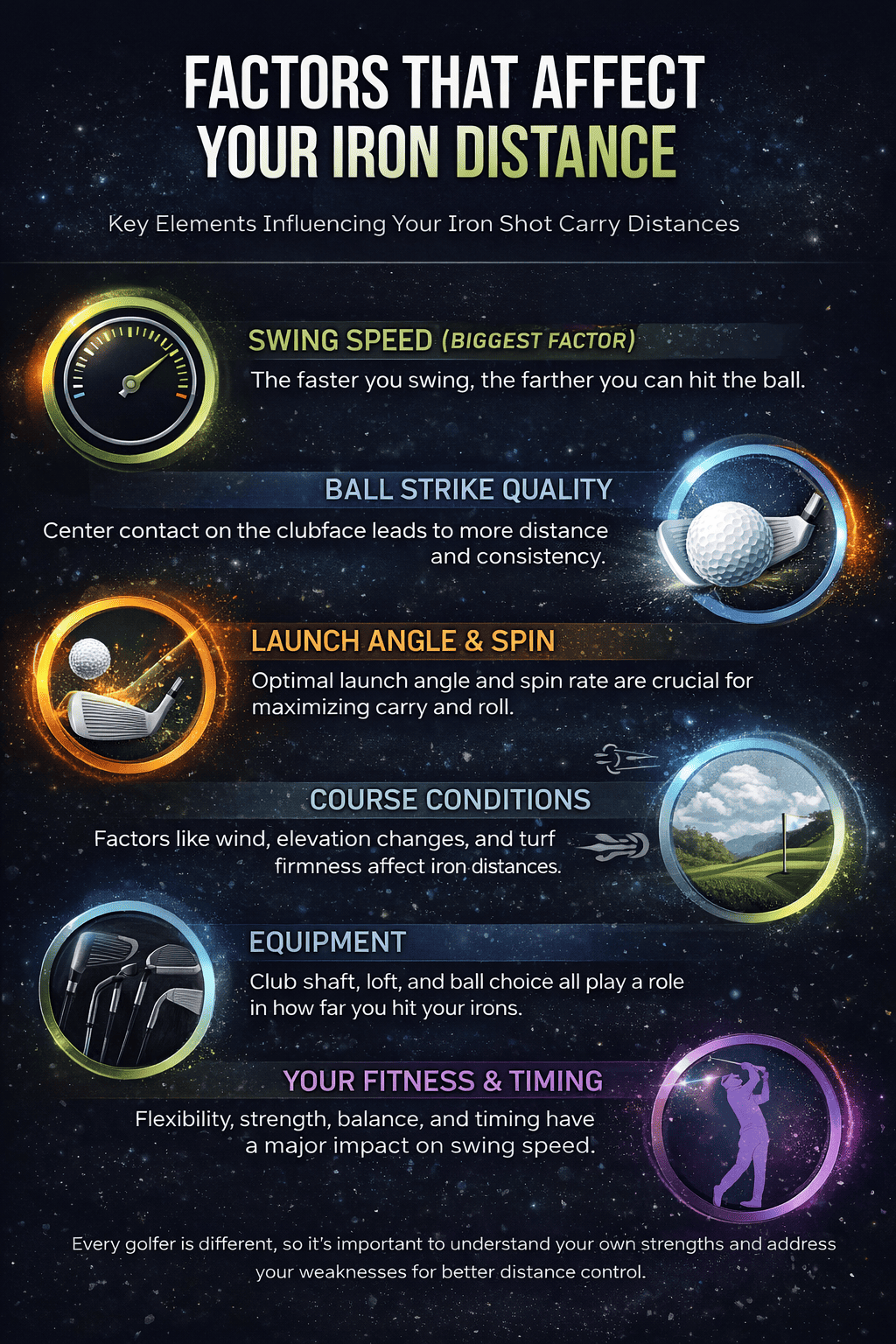
According to the USGA and R&A Joint Distance Report, the average iron loft has decreased by about 4 degrees since 1980, while shaft lengths have increased. In practical terms, a modern “7-iron” in a game improvement set might have the same loft as a traditional 5-iron.
Even within the same brand, loft varies significantly; the Titleist T100 7-iron (popular on the PGA Tour) has 34° of loft, while the T200 sits at 30.5°. Manufacturers like Callaway, TaylorMade, and Titleist all use different loft specs across their model lines.
The same applies to shaft flex: it matters more than many amateurs appreciate. A shaft that’s too stiff for your swing speed can rob you of 10–20 yards per club as a result of lowered launch angle and reduced ball flight.
Getting a proper club fitting that checks loft, lie angle, shaft flex, and shaft weight is one of the quickest ways to optimize your distance without altering your swing. The golf ball you play impacts distance, too.
Firmer, lower-spin balls like a Titleist Pro V1x tend to roll more, and softer, higher-spin balls give you more stopping power but may carry slightly shorter.
Environment: Altitude, Temperature, and Wind
Environmental conditions can shift your iron distances by 10–20% in extreme cases. Altitude is the biggest factor; at elevation, thinner air reduces aerodynamic drag, adding approximately 1.1–1.2% more carry distance per 1,000 feet above sea level.
A 150-yard 7-iron at sea level becomes roughly 159 yards in Denver (5,280 feet). Temperature is the second factor; cold air is denser, so a round in 10°C (50°F) weather plays several yards shorter than one in 30°C (85°F).
A headwind can knock 10 or more yards off an iron shot, while a tailwind can add the same. Wet or soft ground conditions eliminate roll, making carry distance, not total distance, the only number that matters for club selection on rainy days.
Strike Quality: Centre Contact and Dispersion
For most amateurs, inconsistent strike location is the single biggest reason their iron distances vary so much from shot to shot. Every quarter inch away from the sweet spot reduces energy transfer, ball speed, and carry distance.
Launch monitor data from TrackMan and GCQuad consistently shows that golfers who improve their center-face contact gain 8–15 yards of carry without any increase in swing speed.
Dispersion, the spread of your shots around your average, is at least as important as the average itself.
A golfer with a 7-iron that averages 145 yards with 8-yard dispersion will outscore one who averages 155 yards with 25-yard dispersion every time, because consistent approach shots lead to more greens in regulation and lower scores.
How to Measure Your Real Iron Distances
Launch monitors are the gold standard for measuring carry distance, ball speed, launch angle, and spin rate. Professional-grade options, such as TrackMan and Foresight GCQuad, are used by tour players and elite fitters. Consumer-grade monitors, such as the Garmin Approach R10 and SkyTrak, bring this data within reach of everyday golfers at a fraction of the cost.
Shot-tracking systems like Arccos Caddie and Shot Scope GPS record your distances automatically during rounds, stripping out mishits to give you a “Smart Distance” or “Performance Average” that reflects real on-course performance. These systems are especially valuable because they capture data from actual playing conditions, wind, temperature, elevation, and pressure. not the controlled environment of a simulator.
Building your yardage card: Hit 15–20 shots per club with a launch monitor or track 5–10 rounds with a GPS. Use the average, not your best strike. Record both carry and total distance. Note the conditions. Update your card seasonally; your winter distances will differ from summer. A laminated yardage card in your bag or saved in your phone’s notes app is worth more to your scoring than any swing tip on the internet.
Key Factors That Influence Iron Distances
Swing Speed and Its Impact
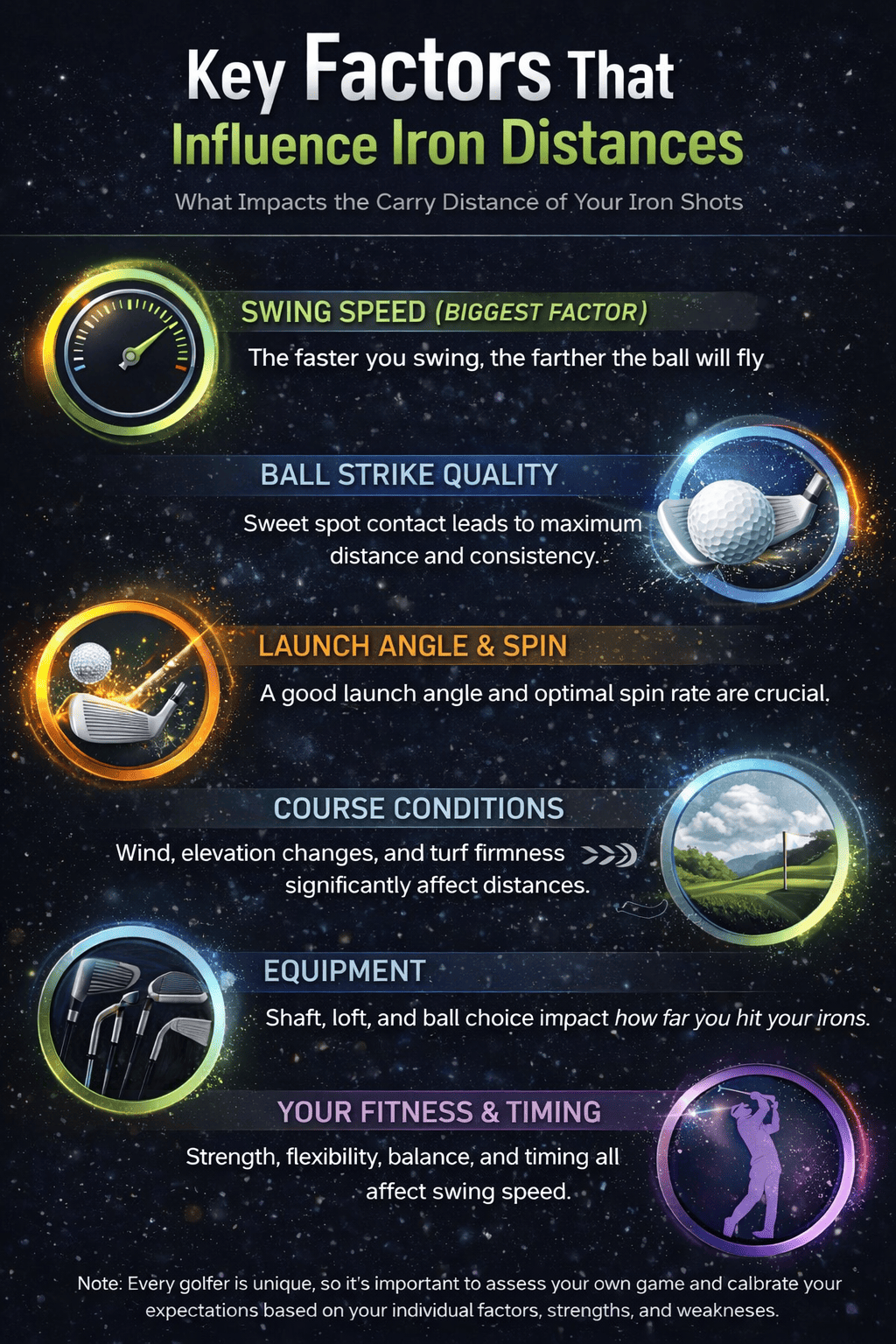
Maximum distance isn’t so much determined by the irons you own as it is the speed at which your clubhead travels. Faster speeds mean more ball speed and, generally, more carry. For instance, a 7-iron struck at 85–90 mph of clubhead speed will travel significantly farther than the same iron hit with a swing speed of 70–75 mph.
So, too, do spin and launch with speed. Quicker removes launch and can adjust spin rates; excessive spin might take off the rollout. When you hit the 8-iron, for example, use a launch monitor or simulator to record your ball speed, launch angle, and spin for each iron.
Quality of Contact and Consistency
Where you strike the face changes distance more than you might think. A shot struck on the toe, or low on the face loses ball speed and can drop 10–30 yards compared to a centered hit. Even small toe or heel misses reduce carry and change dispersion.
Consistency matters for reliable iron distance. If your strike varies, your yardage gaps between irons will blur, and you’ll face poor club choices on the course. Practice drills that focus on hitting the center of the face, like impact tape checks, half-swings, and slow-motion reps to groove a repeatable strike.
Frequently Asked Questions
What is the average distance for each iron for a beginner golfer?
Beginner golfers (typically 25+ handicap or in their first 6–12 months of playing) hit their irons considerably shorter than what most online guides quote. Strike inconsistency is the biggest factor; when contact moves around the clubface, ball speed drops, and so does distance.
A beginner can expect to hit a 4-iron around 130–160 yards (119–146 metres), a 5-iron around 120–143 yards (110–131 metres), a 6-iron around 115–137 yards (105–125 metres), a 7-iron around 105–131 yards (96–120 metres), an 8-iron around 95–122 yards (87–112 metres), a 9-iron around 85–113 yards (78–103 metres), and a pitching wedge around 75–102 yards (69–93 metres).
How far should a 7-iron go on a full swing in meters?
The 7-iron is widely considered the benchmark club in golf; even the USGA uses it to recommend which tees golfers should play from. In full swing, expected distances in meters vary significantly by skill level.
A scratch golfer typically hits a 7-iron around 155–165 meters. A 5-handicapper averages around 144–150 meters. A 10-handicapper comes in around 135–149 meters. A 15-handicapper sits at roughly 123–141 meters. A 20-handicapper manages around 115–131 meters. And a 25+ handicapper hits it roughly 107–120 meters.
How far should you hit a 9-iron in meters?
The 9-iron is a scoring club; it’s the iron most amateurs hit the green with most consistently, regardless of handicap level.
A scratch golfer hits a 9-iron roughly 128–142 meters. A 5-handicapper averages 123–131 meters. A 10-handicapper hits around 111–132 meters. A 15-handicapper hits it about 105–121 meters. A 20-handicapper manages roughly 99–113 meters. And a 25+ handicapper carries it around 91–103 meters.
How far should you hit a 4-iron in meters, and when should you use it?
The 4-iron is the longest traditional iron most golfers still carry, and it’s one of the hardest clubs in the bag to hit well.
A scratch golfer hits a 4-iron roughly 170–204 meters (186–223 yards). A 5-handicapper averages 162–188 meters (177–206 yards). A 10-handicapper comes in at 151–183 meters (165–200 yards). A 15-handicapper manages 142–169 meters (155–185 yards). A 20-handicapper hits it around 133–157 yards (145–172 yards). And a 25+ handicapper carries it roughly 122–146 meters (133–160 yards).
Should I replace my long irons with hybrids? At what handicap does it make sense?
For most golfers, the answer is yes, and the data strongly supports it.
At 20+ handicap, long irons (3-iron, 4-iron, 5-iron) are essentially non-functional scoring clubs. The greens-in-regulation rate with a 4-iron for a 25-handicapper is just 7%, and the distance gap between the 4-iron and 6-iron compresses to as little as 15–17 yards. A 4- or 5-hybrid will launch higher, fly farther, land softer, and be far more forgiving on mis-hits.
At a 15 handicap, the 4-iron and 5-iron start to show improvement, but still only hit the green about 11% of the time from 160–180 yards. Most teaching professionals recommend 15+ handicappers carry no iron longer than a 6-iron.
Why do my irons all go roughly the same distance? How do I fix compressed yardage gaps?
This is one of the most common frustrations in amateur golf: hitting your 6-iron, 7-iron, and 8-iron all roughly the same distance.
Shot Scope data shows that the 6-iron-to-7-iron gap shrinks to just 5 yards for 20- and 25-handicappers, and many higher-handicap players effectively have three or four clubs that all travel 130–140 yards.
The root causes are usually threefold. First, inconsistent strike location. When contact moves around the clubface from shot to shot, ball speed varies wildly. A well-centered 7-iron might go 145 yards, but a toe hit might only travel 125, which is the same as your average 9-iron.
Do iron lofts vary between brands? Can two “7-irons” go completely different distances?
Absolutely, and this is one of the most misunderstood topics in golf. The number stamped on your iron tells you almost nothing about how far it should go unless you also know the loft.
Since 1980, the average iron loft has decreased by about 4 degrees according to the USGA Distance Report.
Modern game-improvement irons push this even further; a “7-iron” in some sets now has the same loft as a traditional 5-iron from the 1990s.
For example, the Titleist T100 7-iron has 34 degrees of loft, while the T200 sits at just 30.5 degrees. That 3.5-degree difference alone produces 10–15 yards of extra distance.