PAGE CONTENTS
ToggleWhat Is a Mid Handicapper in Golf? Handicap Range, Scores & What It Means for Playing Scotland
KEY TAKEAWAYS
– A mid handicapper holds a Handicap Index between 10 and 20 under the World Handicap System (WHS), administered jointly by the R&A and USGA.
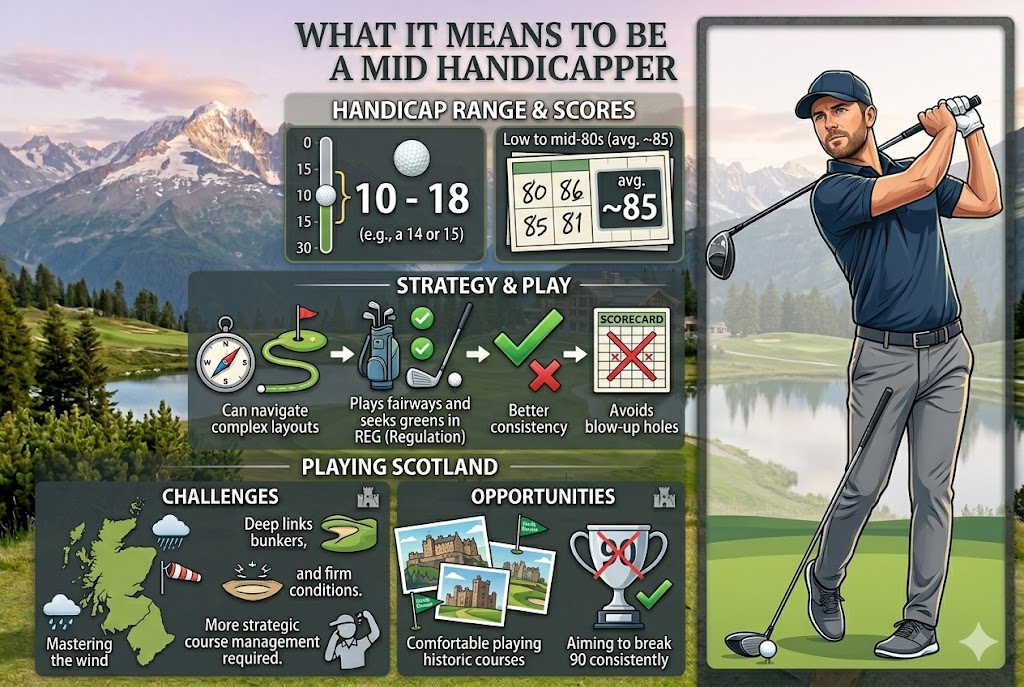
– Typical scores range from around 84–85 (lower-mid, handicap 10–12) to around 93–95 (upper-mid, handicap 17–20) on a par-72 course.
– The average male golfer’s Handicap Index globally sits at approximately 14–15, placing the majority of club players firmly in the mid-handicap band.
– Roughly 44% of male golfers who maintain an official USGA/WHS – Handicap Index are mid handicappers, making this the most common skill group in the game.
– The Old Course at St Andrews requires a maximum Handicap Index of 24 for men and 36 for women to enter the daily ballot; most mid handicappers qualify comfortably.
– Links golf in Scotland often rewards mid-handicap play more than players expect, firm fairways, wide landing areas, and the ground game offset many of the inconsistencies typical at this level.
You’re standing on the 1st tee at Kingsbarns Golf Links, the Firth of Forth stretching grey and silver behind the flag, a 20-mile-per-hour crosswind already tugging at your collar. You’ve broken 85 twice this season, had a couple of rounds in the high 90s, and spent most of your summer somewhere in between. Before you teed it up here, someone at the clubhouse asked what you play off. You said 14. “Ah, a mid handicapper,” they replied, and handed you a yardage book.
But what does being a mid handicapper actually mean, and what does it tell you about the kind of golf you can expect to play in Scotland?
This guide answers both questions. By the end, you’ll understand where the mid-handicap range sits, what your scores and stats typically look like at this level, and why Scotland’s links courses are, for many golfers in this bracket, a better fit than they ever imagined.
What Is the Official Handicap Range for a Mid Handicapper?
Low, Mid, and High Handicap: How Golfers Are Classified
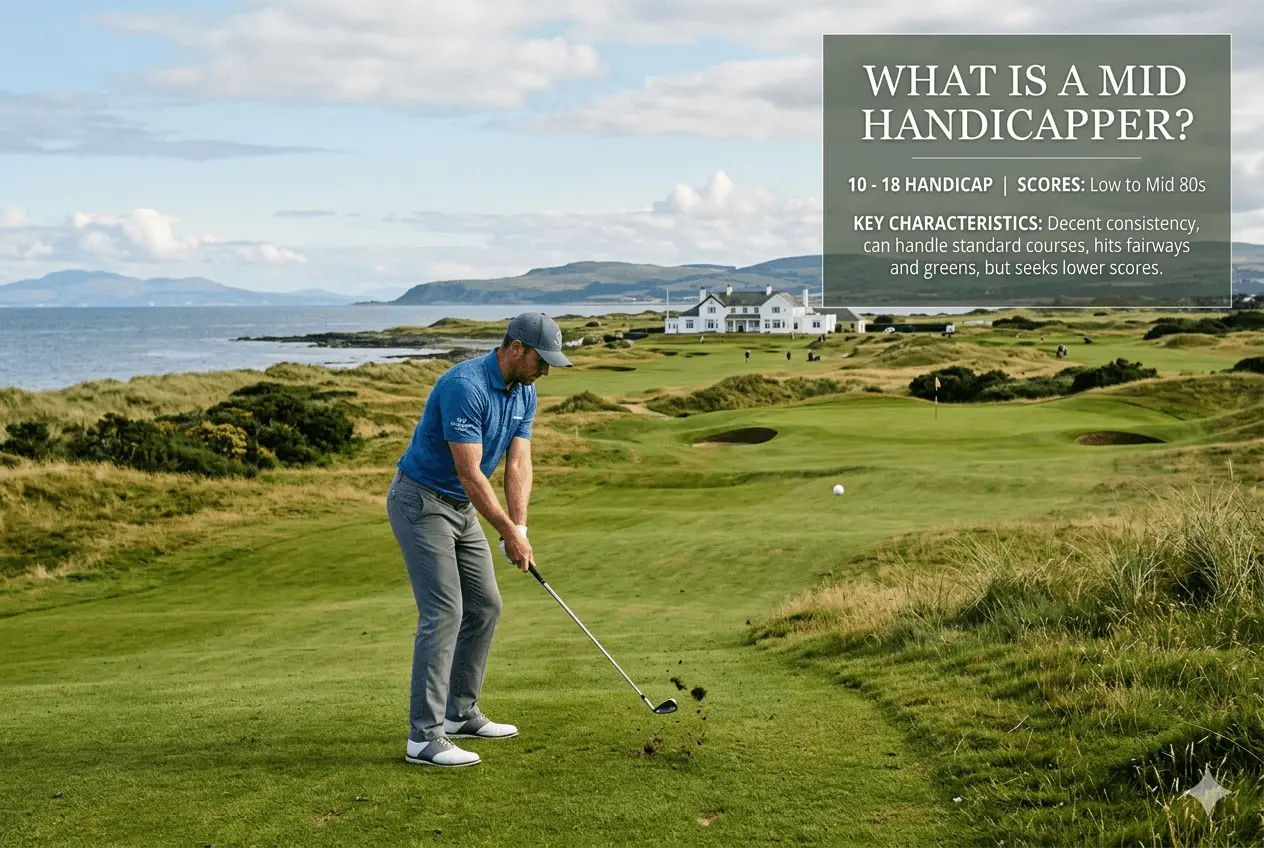
The informal three-tier classification works as follows: a golfer with a Handicap Index of 1–9 is considered a low handicapper or single-figure player; a golfer with a Handicap Index of 10–20 falls into the mid-handicap range; and anyone with an index above 20 is generally described as a high handicapper. Scratch golfers those playing off zero sit apart entirely, as do plus-handicap players, who are expected to score below the course rating on their best rounds.
Golf Monthly notes that this grouping is informal and not enshrined anywhere in the rules of golf. Nobody will check your card at the door and refuse you entry based on whether you are 9.9 or 10.1. But it is a useful shorthand, and for the purposes of trip planning, equipment selection, and course choice, it matters.
How the World Handicap System Calculates Your Handicap Index
Your Handicap Index under the World Handicap System, the single global standard introduced in 2020 by the R&A and USGA, is not an average of your scores. It is calculated using the best 8 Score Differentials from your most recent 20 rounds. A Score Differential adjusts your gross score for the course rating and slope rating of the course you played, so that a round at a demanding links like Carnoustie Golf Links and a round at a modest parkland are comparable.
That calculation has an important implication: your Handicap Index reflects your potential, not your average. It is designed to represent what you can do on a good day, not what you typically do. This is why a 15-handicapper who occasionally shoots 85 will most often card a score closer to 90 or 91 the index is built from the outliers, not the middle.
Is There an Official Definition of “Mid Handicapper”?
There is no governing body definition. But the consensus across golf media and the equipment industry is that 10–20 covers the mid-handicap bracket. Some sources draw the lower boundary at 11 or 12, particularly when distinguishing mid-handicap from the single-figure fringe. For practical purposes, and certainly for course selection in Scotland, the 10–20 range is the working definition used throughout this guide
What Scores Does a Mid Handicapper Typically Shoot?
Lower-Mid Handicap (10–12): Scoring in the Mid-80s
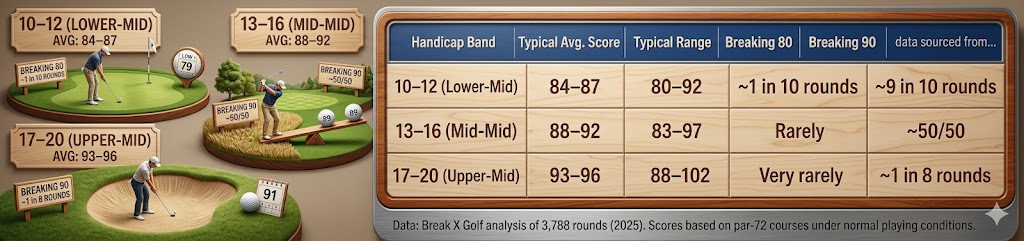
A golfer in the 10–12 range averages roughly 84–87 on a par-72 course, according to analysis published by Break X Golf based on 3,788 rounds from 1,116 players. Breaking 80 happens approximately once every ten rounds — a real achievement, but not a fluke. These players have largely left the 90s behind; scoring 92 is now a genuinely poor round rather than an average Tuesday.
This is the level at which your misses are mostly manageable. You can hit the fairway most of the time, and your iron play gives you a realistic chance at par when you find the short stuff.
Mid-Mid Handicap (13–16): The 88–93 Band
A 15-handicapper averages around 89 on a par-72 course. Breaking 90 is a coin-flip roughly half of rounds come in at 89 or better, and half don’t. The scoring range is wide: a good week might produce an 84, while a difficult course or testing wind can push the card to 94 without anything going catastrophically wrong.
This is the most densely populated part of the handicap spectrum. According to the USGA, the most common handicap band for male golfers is 13–14, and the average Handicap Index for men across WHS-affiliated clubs globally is approximately 14–15. If you play to this index, you are, by every measure, an average club golfer and that is a much better position to be in for a Scottish links trip than most players assume.
Upper-Mid Handicap (17–20): Breaking 90 as a Milestone
A 20-handicapper averages around 94 on a par-72 course, staying under 100 on roughly nine in ten rounds. Breaking 90 happens approximately once every eight rounds and remains a genuine milestone when it arrives. The scoring range is wider at this level, a good round might come in at 88, while a difficult day can reach the high 90s without a single disaster hole.
The table below summarises typical scoring patterns across the mid-handicap band:
| Handicap Band | Typical Avg. Score | Typical Range | Breaking 80 | Breaking 90 |
|---|---|---|---|---|
| 10–12 (Lower-Mid) | 84–87 | 80–92 | ~1 in 10 rounds | ~9 in 10 rounds |
| 13–16 (Mid-Mid) | 88–92 | 83–97 | Rarely | ~50/50 |
| 17–20 (Upper-Mid) | 93–96 | 88–102 | Very rarely | ~1 in 8 rounds |
What Are the Typical Strengths and Weaknesses of a Mid Handicapper?
Mid handicappers are capable of playing excellent golf. The best rounds at this level are genuinely impressive fairways hit, greens found, pars made in clusters. What separates the mid-handicapper from the single-figure player is not the ceiling, but the floor.
Where Mid Handicappers Lose Most Shots
According to Golf Sidekick’s analysis, mid handicappers hit approximately 3–4 greens in regulation per 18 holes and average 2–3 three-putts per round. Those two numbers tell the story. Missing 14 greens per round means scrambling constantly and even a competent short game cannot consistently convert from rough, tight lies, and uneven ground.
The other persistent issue is the blow-up hole. Mid handicappers typically play most holes well, but one or two holes per round produce a double or triple bogey that inflates the card. Penalty strokes from pot bunkers, gorse, out-of-bounds, or water are the primary cause. Reducing these outliers, rather than manufacturing more birdies, is the fastest route to a lower index.
What Sets Mid Handicappers Apart from Low Handicappers
A scratch golfer hits around 10 greens in regulation per round compared to a 15-handicapper’s 4–5, according to data from Break X Golf’s handicap statistics analysis.
The single-figure player also scrambles more successfully getting up and down around 37–50% of the time versus the mid-handicapper’s 21–31%. These are significant gaps, but they are not unbridgeable. The difference is consistency: the low handicapper avoids the moments when the game falls apart entirely.
The Consistency Gap: Why One Great Round Doesn’t Lower Your Handicap
Because the World Handicap System uses only your best 8 of 20 rounds, shooting 80 twice doesn’t make you a 10-handicapper if your other 18 rounds average 94. The index tracks potential, not day-to-day performance. For a golfer planning a Scotland trip, this distinction is liberating: your best golf is already in the index. What you are working toward on a links course is delivering that performance more reliably, round after round.
Can a Mid Handicapper Enjoy Golf in Scotland?

The majority of Scottish golf courses have no minimum handicap requirement for visitors. The exceptions are a handful of high-demand championship venues. The Old Course at St Andrews, the most famous course in the world, routed over the same coastal ground where the game was first played, requires a maximum Handicap Index of 24 for men and 36 for women to enter the daily ballot, administered by St Andrews Links Trust. A 15-handicapper enters that ballot comfortably. Crucially, the Handicap Index must be an official WHS index from a registered club, a score you have been informally “playing off” at home does not qualify.
Carnoustie Golf Links Championship Course, host of multiple Open Championships, requests a Handicap Index of 28 or below. Muirfield, the home of The Honourable Company of Edinburgh Golfers, operates by separate club application. Most other courses, including Royal Dornoch Golf Club, Kingsbarns Golf Links, Gullane Golf Club, and North Berwick Golf Club, are open to all visitors without a handicap restriction.
Which Scottish Courses Suit Mid Handicappers Best?
The short answer is: most of them. Scotland has over 550 golf courses, according to VisitScotland, and the range spans from the severe challenge of Carnoustie’s Championship Course to the entirely welcoming Balcomie Links at Crail Golfing Society, a course laid out by Tom Morris where a 19-handicapper can play a competitive, enjoyable round.
Several specific courses are particularly well matched to the mid-handicap visitor:
Kingsbarns Golf Links
(Fife, opened 2000) is widely praised for its accessibility. The course's generous fairways and gentler undulations reward confident, positioned play over pure power. From the forward tees, it offers a realistic test for mid-range players without ever becoming discouraging.
Royal Dornoch Golf Club's Struie Course
(Sutherland, par 71, 6,192 yards) is the companion to the Championship Course and, at roughly half the green fee, plays genuine links golf over the same terrain. It provides an excellent test for a mid-handicapper who is not yet ready for the severity of the Championship layout.
Carnoustie Burnside Course
(Angus) runs alongside the Championship Course, sharing the same land and conditioning, and plays to a more forgiving yardage. For a mid-handicapper visiting Carnoustie, a round on the Burnside the afternoon before the Championship Course the following morning is a proven way to learn the terrain, the wind patterns, and the character of the greens.
The Eden Course at St Andrews Links
(Fife, par 70, 6,250 yards, ~£75 peak) was originally designed by Harry Colt in 1914 and offers strategic, accurate links golf at a fraction of the Old Course's green fee. It is a genuinely good course, not just a stepping stone, and is often overlooked by visitors fixated on the famous three.
Why Links Golf Can Actually Suit a Mid Handicapper’s Game
Here is a perspective most visiting golfers never hear: links golf, properly understood, is well suited to the mid-handicap game.
On a typical tree-lined parkland course in North America or continental Europe, the mid-handicapper who misses a green ends up in rough that demands a high, precise recovery. The premium is on aerial precision, exactly what mid-handicappers lack most. Links golf removes that penalty. The turf around a links green is mowed firm and tight. A ball that misses 30 feet left of a links green sits on a surface from which a bump-and-run with an 8-iron is considerably more reliable than a high pitch. The ground game rewards common sense over swing perfection.
Firm fairways on a dry links day also add 20–30 yards to every drive, welcome news for a mid-handicapper who is already approaching longer par-4s with a 5-iron rather than a 7. Add in the absence of tree corridors that punish a pushed drive, and the generous routing of courses like the Old Course and Kingsbarns, and the conditions are kinder than they look.
How Should a Mid Handicapper Approach Links Golf in Scotland?
The Shot Mid Handicappers Must Learn Before Visiting Scotland: The Bump-and-Run
The bump-and-run is not a specialist shot; it is the foundational short-game technique of links golf, and it should be the default approach for any mid-handicapper arriving at a Scottish course. MyGolfSpy’s links golf guide recommends learning to take a 7-iron or 8-iron from up to 40 yards off the green, land the ball on the fringe, and let it release toward the flag.
Practice this at home before you arrive: take a mid-iron to the chipping green, land the ball well short of the putting surface, and let it run out. You will use this shot a dozen times per round in Scotland. Your worst bump-and-run will almost always be a better outcome than your worst high wedge into a coastal wind.
Course Management on Links Land: Playing Smart Over Playing Long
The mid-handicapper who scores well in Scotland treats every tee shot as a positioning exercise, not a distance competition. Links fairways can be wide, but the penalties — revetted pot bunkers, gorse, burn crossings — are positioned to punish the aggressive line. Colin Montgomerie’s advice on links management is to select a club you can reliably put in play and accept that position is more valuable than distance.
The numbered approach below gives you a practical pre-shot routine for links tee shots:
- Identify the safe side of the fairway, usually the side away from the prevailing wind and the most severe bunkers.
- Choose a club that reliably reaches that position, even if it leaves a longer second shot.
- Tee the ball lower than usual and aim for a flatter, more penetrating ball flight.
- Accept the running bounce: on firm turf, a well-struck drive will travel further than the carry distance suggests.
- Reassess after watching playing partners' tee shots — the bounce patterns will tell you more about the turf than any rangefinder.
Why Pot Bunkers Are the Mid Handicapper’s Biggest Risk in Scotland
The deep, revetted pot bunkers at Scotland’s championship links, the face-on bunkers at St Andrews, the Hell Bunker on the 14th hole of the Old Course, the Spectacles at Carnoustie, are designed to punish the indecisive shot. For mid-handicappers, the risk is not entering the bunker but mishandling the exit. The revetted face of a Scottish pot bunker does not permit a running-out shot: you must take the ball directly upward and clear the lip, or play sideways.
As Global Golfer Magazine advises, if you are not at least 90% certain of clearing the lip, take the sideways or backward exit. Accepting a dropped shot and leaving the ball in the fairway preserves a bogey. Catching the revetted face and dropping to the base of the bunker turns a bogey into a double or worse. Conservative bunker play saves mid-handicappers an average of one or two shots per round at an unfamiliar links course.
Common Questions About Mid Handicaps and Golf in Scotland
What handicap do I need to play the Old Course at St Andrews?
Is a 15 handicap good enough for Carnoustie?
Will I enjoy Scotland if I'm a mid handicapper?
How do I improve from mid to low handicap before my Scotland trip?
Conclusion
A mid handicapper is a golfer with a Handicap Index between 10 and 20, the most common skill level among those who maintain an official WHS handicap, and the exact profile that Scotland’s links courses are built to challenge and reward. Your typical scores of 84–95 reflect real competence, real inconsistency, and real room for growth: in other words, the state of permanent, enjoyable tension that defines golf for most of us who love it.
The practical takeaway for Scotland is this: a 14-handicapper who understands the bump-and-run, plays smart off the tee, and treats pot bunkers with appropriate respect will have a better experience at a course like Kingsbarns or Royal Dornoch’s Struie than a low-handicapper who arrives expecting to reproduce their inland game on links turf.
For course recommendations matched to your specific handicap band, our guide to Scotland’s best golf courses for mid-handicap visitors walks through the full range, from the accessible welcome of Crail Balcomie to the serious test of the Old Course. And if you are still building your case for the trip, our Scotland golf itinerary for mid-handicap visitors gives you seven days of links golf designed precisely for this level.
The Old Course, the Struie, Kingsbarns at last light, they are all waiting. Your handicap is not a barrier. It is, on Scotland’s links, a starting point.