PAGE CONTENTS
ToggleA golf trip to Scotland is not just a holiday. It is a world class sporting pilgrimage to the very birthplace of golf, a country where the game was invented, refined, and elevated into a global obsession over six centuries.
Every fairway tells a story. Every link’s course carries a history that no purpose built resort can replicate.
- £2,000 → A lean, strategic budget experience
- £5,000 → A well-balanced premium trip with real course highlights
- £12,000+ → A full luxury golf tour with elite access and white glove service
Two golfers can visit Scotland in the same month, play similar courses, and spend £3,000 apart in total.
The difference comes down to planning, timing, accommodation positioning, and course mix decisions.
This guide breaks down real 2026 pricing, hidden costs, optimisation systems, and the professional travel strategies used by experienced golf travellers who get maximum value from every pound spent.
Real Cost Structure of a Scottish Golf Trip
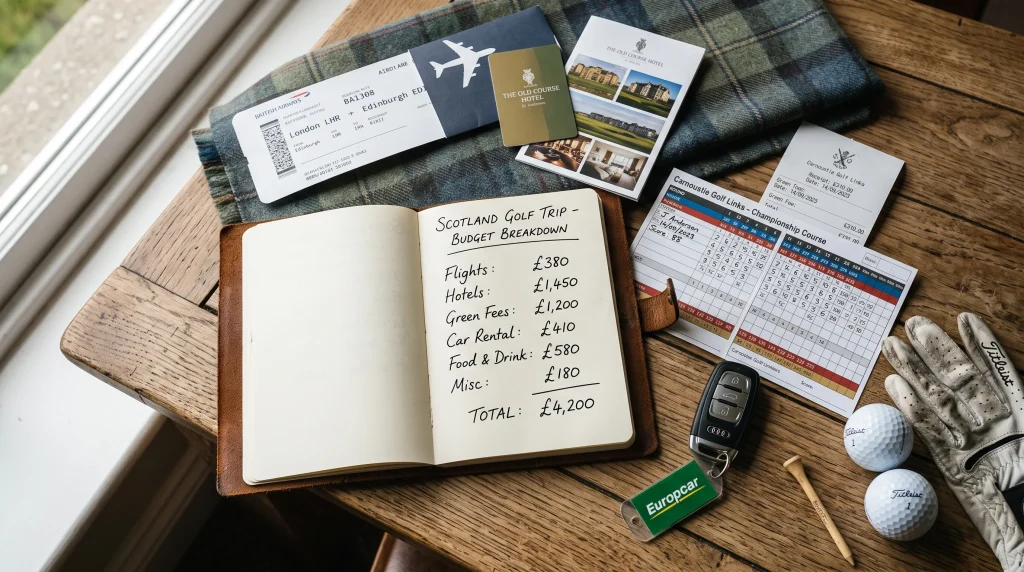
(This image is just for illustrative purpose only)
Most golfers approach planning a trip to Scotland by Googling “St Andrews green fee” and building outward from there.
This is exactly the wrong approach. A Scotland golf trip is not one single expense; it is a multi expense, layered financial system where each layer influences every other layer and where small decisions in one area create large ripple effects across the entire budget.
Understanding this structure before you book a single thing is the difference between an optimised trip and an expensive disappointment.
Flights are the most visible cost, and the one most golfers obsess over, but paradoxically, they are not the most important cost driver in a Scottish golf trip.
- From US/Canada: £500 to £1,200 average for economy class return
- Business class: £1,500 to £3,000+ depending on airline and route
- From Europe: £80 to £300 for budget or standard carriers
Flight pricing is heavily dependent on two factors: the season you travel and how far in advance you book.
Booking more than 90 days out consistently delivers 25 to 40% savings compared to last minute purchases.
Edinburgh Airport (EDI) is the primary gateway for most Scottish golf trips, with Glasgow (GLA) serving as a useful alternative for Ayrshire-focused itineraries.
| Category | Type / Option | Price / Range | Notes |
|---|---|---|---|
| Accommodation Cost | |||
| Location Strategy | Course-adjacent hotel | Premium pricing | Priced by global demand, not local rates — can exceed cost of golf itself |
| Location Strategy | Town 20–30 min away | 30–50% cheaper | Same golf access, lower cost per night |
| Property Type | Self-catering / guesthouse | Lowest per-person cost | Best for groups, zero impact on golf experience |
| Green Fees Cost | |||
| Course Tier | Municipal courses | £15 – £30 | Open access, smaller towns |
| Course Tier | Championship / elite courses | £295 – £500+ | Requires months of planning or a booking service |
| Access Type | Ballot entry / handicap cert | Face value + hidden cost | Access difficulty raises effective price beyond face value |
| Transport Cost | |||
| Region | Fife (St Andrews area) | — | Core eastern cluster |
| Region | Ayrshire (southwest coast) | — | Separate region, added drive time |
| Region | Highlands / North | — | Furthest cluster, most driving |
| Itinerary Load | 7-day multi-region trip | 6–8 hrs driving | On top of 5–6 rounds of golf — risk of exhaustion |
| Vehicle Option | Private hire | Highest cost | Comfortable but expensive |
| Vehicle Option | Self-drive rental | Moderate cost | Flexible, requires adjusting to narrow roads & left-hand driving |
| Vehicle Option | Group shared vehicle | Lowest cost | Most cost-effective option overall |
| Biggest Cost Lever | Accommodation location & course mix decisions | ||
Why Golf Pricing in Scotland Varies So Much

(This image is just for illustrative purpose only)
Scotland does not operate on a standard hospitality pricing model. It operates on a demand driven golf economy, one where scarcity, prestige, and global competition for tee times drive prices in ways that have very little to do with the local cost of living.
- Seasonal Demand Explosion: Peak vs Off Peak
- Between May and September, Scotland experiences a global golf tourism surge that reshapes pricing across every sector simultaneously:
- Hotels in golf towns raise room rates by 40 to 100% compared to winter pricing
- Tee times at championship courses become genuinely scarce and often need booking 6 to 12 months in advance
- Transport and rental car availability tighten, pushing prices upward
- Dining in popular areas becomes more expensive as tourist demand overwhelms local supply
The same trip taken in October, often with near identical weather to early September, can cost 30 to 50% less across every category. This is not a marginal saving.
On a £6,000 peak-season trip, the off-peak equivalent might cost £3,800 to £4,200 while delivering virtually the same golf experience.
Why Cost Changes So Much Between Travellers
(This image is just for illustrative purpose only)
Two golfers can travel to Scotland in the same week, play similar courses, and return home having spent the following:
- £3,000 (one traveller)
- £9,000 (another traveller)
This is not unusual; it is extremely common. The cost difference is driven entirely by four strategic decisions:
Hotel location strategy: staying inside or outside major golf towns creates a cost difference of £50 to £200 per night.
Course mix decisions: the ratio of elite to mid and tier to budget courses determines whether green fees average £100/round or £320/round.
Travel routing efficiency: Poor itinerary design creates unnecessary driving, extra nights, and logistical costs that compound across the trip.
Seasonal timing, the same trip in June versus October, can differ by £1,000 to £2,500 in total cost.
Elite golf courses, Scotland
Some Scottish golf courses do not price themselves as local businesses. They price themselves as global heritage experiences and demand support for those prices year after year.
Courses like St Andrews Old Course, Royal Troon, Muirfield, Carnoustie, and Turnberry (Trump Turnberry) operate on a pricing model driven by:
- Reputation demands golfers travel from 50+ countries specifically to play these courses
- Limited availability: course capacities are fixed and cannot expand to meet demand
- Global booking competition tee time allocation is competed for by tour operators, private bookers, and ballot entries worldwide
What this means in practice: these courses can charge £250 to £500 per round, not because of their operating costs but because thousands of golfers will pay that price and more for a single round. This is classic scarcity economics applied to golf.
Tee time availability
Several of Scotland’s most famous courses use access restriction systems that create what can be described as ‘availability inflation’, a situation where the true cost of playing a course is significantly higher than the published green fee.
- Ballot systems (like St Andrews), where you enter a lottery and may or may not receive a tee time
- Handicap certificate requirements that restrict access to verified golfers of a certain skill level
- Member introduction requirements where visitor access depends on knowing a member
- Restricted visitor windows where public access is limited to specific days or times
The practical effect: obtaining a tee time at a ballot course may require paying a booking agent’s fee, planning your entire itinerary around a narrow availability window, or booking a qualifying hotel package that bundles accommodation costs.
Green fees Scotland strategy
| Course Type | Price Range | Access Difficulty | Strategic Purpose |
|---|---|---|---|
| Municipal Courses | £15–£50 | Easy, walk-on available | Warm-up rounds, extra days |
| Standard Links | £60–£150 | Moderate; booking recommended | Core experience, volume |
| Championship Links | £180–£350 | High, months of planning | Signature rounds |
| Elite Courses | £250–£500+ | Very High, ballot/restricted access | Bucket-list anchor rounds |
| Strategy | Mix all four tiers to balance cost, access & experience | ||
golf travel strategy used by travellers
This is the single most effective cost and management tool in Scottish golf travel, and it is used consistently by experienced golfers and professional tour planners alike.
The fundamental insight is this: playing only elite courses is not the optimal Scotland golf experience; it is an expensive, exhausting version of it.
Even the world’s greatest golf courses become repetitive when played back to back. Variety in course character, difficulty, and setting is what makes a Scotland trip genuinely memorable.
Expert travellers build their itineraries around a deliberate mix:
- 2 elite courses (the anchor experiences St Andrews, Royal Troon, Carnoustie, etc.)
- 3 to 4 mid-level links courses (authentic Scottish golf at its finest, often underrated internationally)
- 1 to 2 budget or municipal rounds (perfect for arrival days, departure days, or low-pressure afternoons)
This structure creates an itinerary with rhythm, variety, and genuine highlights while keeping the average green fee cost dramatically lower than an all-elite approach.
Accommodation Strategy | Where Most Money Is Saved or Lost
| Area | Budget / Night | Mid-Range / Night | Luxury / Night |
|---|---|---|---|
| St Andrews | £100–£180 | £180–£350 | £400–£800+ |
| Edinburgh | £80–£150 | £150–£300 | £300–£700+ |
| Ayrshire Coast | £90–£160 | £160–£280 | £300–£600+ |
| Scottish Highlands | £80–£140 | £140–£250 | £250–£500+ |
| Best Value Tier | Mid-Range, 20–30 min outside town centres | ||
Why Accommodation in Scotland’s Golf Towns Costs More
The most common and costly mistake Scottish golf travellers make is choosing accommodation based on proximity to famous courses.
It feels logical to stay near the course, wake up, and walk to your tee time. In practice, this approach pays a massive location premium for the convenience that a 25 minute drive eliminates.
Hotels in St Andrews, Troon, and similar golf-famous towns are pricing against global demand from golfers who have been told that staying in town is the authentic experience. The result:
Premium hotel pricing that can be 40 to 70% higher than equivalent quality accommodation nearby
Limited availability during peak season, forcing even higher prices or worse properties
Inflated dining costs in the immediate area around famous courses
A golfer who books a high-quality guesthouse or self-catering cottage 20 to 30 minutes from their main courses, rents a car, and drives in each morning pays dramatically less and often experiences more of Scotland in the process.
Pro-level Accommodation Strategy
Choose a central base, not a course adjacent hotel. Pick a location that puts you within 30 to 45 minutes of your core course cluster.
For Fife-based golf, Perth or Dundee offer excellent value. For Ayrshire, Ayr town itself, rather than the Troon waterfront.
For the Highlands, Inverness rather than direct coastal locations is preferred.
Use self catering properties for groups. A 3 and 4 bedroom self catering house for four golfers costs significantly less per person than four hotel rooms, includes kitchen facilities that reduce dining costs, and provides a social base that many golfers cite as their favourite part of the trip.
Book shoulder dates even within peak months. Sunday to Thursday accommodation rates are consistently lower than Friday and Saturday rates, even in Scotland.
Building your itinerary around this pattern saves meaningful money with no sacrifice in experience.
Real Trip Budget Models | How Travellers Actually Spend Money
| Model | Total Cost (Per Person) | Strategy Type | Experience Level |
|---|---|---|---|
| Budget | £2,000–£3,000 | Aggressive cost control | Authentic golf, limited prestige |
| Balance | £3,500–£5,500 | Optimised mix | Best overall value and experience |
| Premium | £5,500–£8,000 | Experience-first | Elite courses, quality hotels |
| Luxury | £8,000–£12,000+ | Full VIP service | Private transport, exclusive access |
| Recommended for First-Time Visitors | Balance Model | ||
The Insight Most First Time Visitors Miss
When you pay for a higher tier for Scotland golf trip, you are not simply paying for better golf. You are paying for a fundamentally different quality of access:
- Speed tee times secured months in advance with professional booking infrastructure
- Comfort, no logistics stress, no driving fatigue, no schedule juggling
- Exclusivity experiences that are simply unavailable to independent travelers regardless of budget
- Convenience: every element of the trip is pre arranged and flows smoothly
For first-time visitors, the Balanced model delivers the most memorable experience per pound spent.
For return visitors seeking specific elite courses or new regions, the Premium model becomes worthwhile.
Best Time to Visit Scotland
| Model | Total Cost (Per Person) | Strategy Type | Experience Level |
|---|---|---|---|
| Budget | £2,000–£3,000 | Aggressive cost control | Authentic golf, limited prestige |
| Balance | £3,500–£5,500 | Optimised mix | Best overall value and experience |
| Premium | £5,500–£8,000 | Experience-first | Elite courses, quality hotels |
| Luxury | £8,000–£12,000+ | Full VIP service | Private transport, exclusive access |
| Recommended for First-Time Visitors | Balance Model | ||
Hidden Costs Most Golfers Completely Ignore
Every Scotland golf trip budget analysis focuses on the five big categories: flights, hotels, green fees, transport, and food.
What most planning guides fail to adequately address are the genuine hidden costs that accumulate invisibly and can add 10 to 25% to your total expenditure.
Major Hidden Expenses Explained
- Club Rental (£40 to £80 per round) Shipping golf clubs internationally is expensive, logistically complex, and comes with the risk of loss or damage. Many golfers choose to rent clubs upon arrival in Scotland. Rental quality has improved significantly in recent years, with premium sets available at most major courses. However, at £50 to £80 per round across 6 rounds, this adds £300 to £480 to your trip cost, a significant sum that rarely appears in initial planning.
- Caddie Tips (£20 to £50 per round) Scottish caddies are widely regarded as among the most knowledgeable in the world. On links courses, where reading the wind and understanding course strategy is genuinely complex, a good caddie is not a luxury; it is a performance tool. However, tipping caddies is standard practice, and the tip is separate from the caddie fee. Budget £20 to £50 per round for tips, and consider it part of the authentic Scotland experience rather than an optional extra.
- Dining Inflation in Golf Towns Restaurants and pubs in St Andrews, Troon, and other golf-famous towns apply premium pricing during peak season. A meal and drinks that might cost £25 to £35 in Edinburgh can reach £45 to £60 in the same category of establishment in a smaller golf town during July. Across a 10 day trip with two meals out daily, this difference compounds significantly.
- Transport Between Regions Multi-region itineraries, which include both Fife and Ayrshire courses, for example, involve driving distances that most golfers do not pre-calculate. Edinburgh to Turnberry is approximately 70 miles each way. St Andrews to Royal Dornoch is nearly 90 miles. If you are covering multiple Scottish golf regions in one trip, build a realistic transport cost into your planning that accounts for fuel, potential tolls, and the added time that reduces your available golf hours.
- Weather Delays and Rescheduling Scotland’s weather is not reliably golf-friendly even in summer. High winds can make links courses physically difficult or temporarily unplayable. Rain can delay rounds. Coastal fog occasionally closes courses entirely. Building a contingency day or half-day into your itinerary is sound planning, but that extra day carries hotel and subsistence costs that are often not pre-budgeted.
Frequently Asked Questions
How much does a golf trip to Scotland cost in 2026?
A typical 7 to 10 day golf trip costs between £2,000 and £12,000 per person, depending on the season you travel in, the quality of accommodation you choose, and the mix of courses on your itinerary.
The balanced model offering the best overall experience per pound spent typically comes in at £3,500 and £5,500 per person.
What is the cheapest way to play golf in Scotland?
The most effective budget approach combines three strategies: travel in April or October (shoulder season), stay in self-catering accommodation or guesthouses outside major golf towns, and build your course list around municipal and standard links courses with just one or two championship highlights.
This approach can deliver an excellent Scottish golf experience for £2,000 to £3,000 per person.
Why is St Andrews’ Old Course so expensive?
The Old Course at St Andrews carries a unique combination of factors that drive premium pricing: it is the most historically significant golf course in the world, availability is severely limited by both course capacity and the famous ballot system, and global demand from golfers on every continent creates genuine competition for every available tee time.
The ballot system also means that the published green fee represents only part of the real access cost.
How many rounds should I play in a 7 day trip?
The optimal number for most golfers is 4 to 6 rounds across 7 days.
This pace allows for adequate rest between rounds, time for travel between course locations, and the ability to properly appreciate each course rather than grinding through them in exhaustion.
Attempting more than one round per day is generally counterproductive, physically demanding, and financially inefficient.
What is the best month for golf in Scotland?
April and October offer the best combination of reasonable pricing, good course conditions, manageable crowds, and tee time availability. Within peak season, early May and late September offer similar value if shoulder months do not fit your schedule.
Do I need a car for a Scotland golf trip?
In almost all cases, yes. Scotland’s best courses are spread across a large geographic area, and public transport connections between most of the links’ courses are either limited or non-existent.
A rental car gives you the flexibility to design an efficient itinerary, reduces daily transport costs compared to private hire, and allows you to explore the Scottish countryside between rounds, which is itself a significant part of the experience.
Can I mix budget and luxury courses on the same trip?
Yes, and this is not just acceptable; it is the recommended approach used by experienced Scottish golf travellers.
A well-designed course mix typically includes 1 to 2 elite/bucket-list courses, 3 to 4 mid-tier championship links, and 1 to 2 more affordable rounds.
This structure reduces your average green fee cost by 30 and 45% while delivering a more varied, more enjoyable, and ultimately more memorable trip than playing only premium courses from start to finish.